
Costa Mesa homeowners have a unique opportunity to add usable living space without leaving their existing property. With limited land and strong demand for housing in Orange County, an accessory dwelling unit can potentially serve as a rental, guest residence, multigenerational living space, or private home office. But maximizing the return on an ADU requires more than simply adding square footage. Costa Mesa ADU Guide: Maximizing ROI starts with understanding the city’s requirements, designing around the property, and working with an experienced construction team from the beginning.
Costa Mesa has established local ADU standards that work alongside California’s statewide ADU laws. The city identifies ADUs and JADUs as independent living facilities located on the same parcel as a primary residence and notes that its local provisions include a 150-square-foot minimum size, optional parking, and objective design standards affecting issues such as setbacks and two-story construction.
For homeowners considering an ADU, these details matter because the most profitable design is not necessarily the largest one. A successful project balances usable space, construction quality, property layout, permitting requirements, and the needs of future occupants.
What Makes an ADU Guide a Good Investment?
An ADU can create value in several ways.
For some Costa Mesa homeowners, the primary goal is rental income. Others want additional space for aging parents, adult children, guests, or a household member who needs more independence. Some may want an adaptable space that can change functions over time.
The key is designing the unit around a clear purpose.
A well-planned ADU should feel like a complete residence rather than an afterthought placed in whatever portion of the backyard remains available. Layout, natural light, privacy, storage, kitchen functionality, bathroom placement, and access all influence how useful the finished space will be.
The construction team should also consider how the ADU interacts with the existing home. A poorly positioned structure can reduce backyard usability, create privacy problems, or make the property feel crowded.
Costa Mesa Rules Can Affect Your ADU Design
One of the biggest mistakes homeowners can make is choosing a floor plan before understanding the property and local regulations.
Costa Mesa’s ADU regulations address development standards, and the city specifically recommends consulting with a planner before submitting an ADU or JADU project.
The city also has objective standards governing ADUs, including provisions concerning design, setbacks, and how an ADU integrates with the existing property.
That means the available backyard area does not automatically translate into the amount of buildable ADU space.
Property Layout Matters
The location of the existing home, garage, utility connections, access points, fences, trees, and neighboring structures can all influence the most practical ADU location.
A professional builder evaluates these conditions before construction begins.
Instead of asking, “How large can we build?” the better question is, “What ADU design provides the best combination of usable space, compliance, privacy, and long-term value for this property?”
That shift can significantly improve the overall project.
A Typical Costa Mesa ADU ROI Scenario
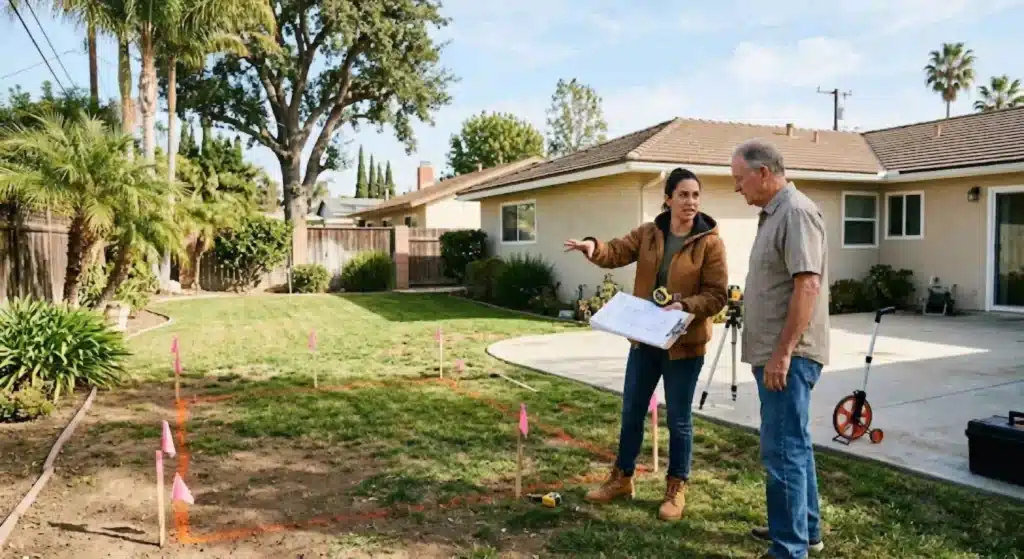
Consider a Costa Mesa homeowner with an underused backyard and a growing need for additional living space.
The homeowner initially considers building the largest ADU that appears possible. However, after evaluating the property, the project team identifies several competing factors: the location of the existing home, access to the backyard, required setbacks, utility connections, and the need to preserve enough outdoor space for the main residence.
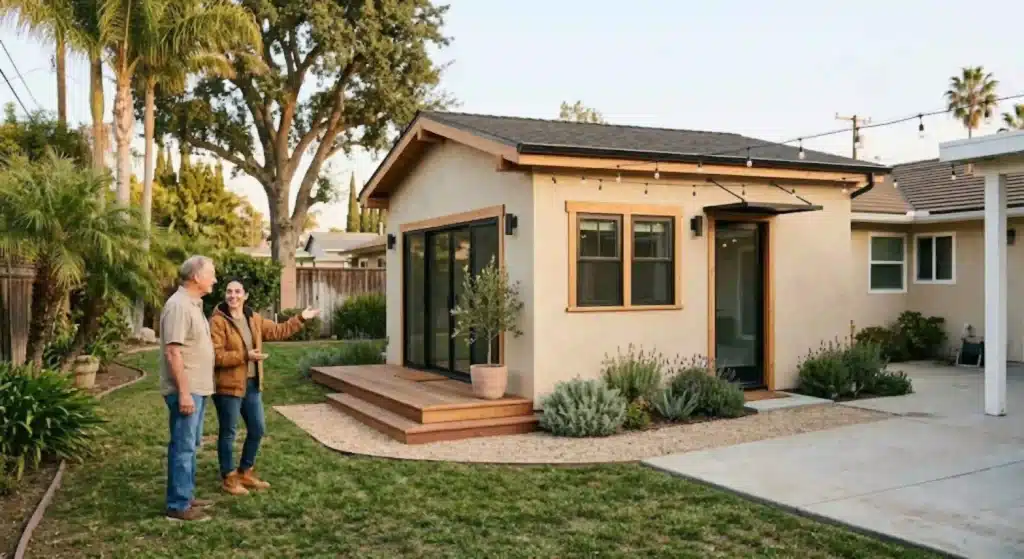
Rather than maximizing square footage alone, the design focuses on creating an efficient independent living environment.
The finished plan prioritizes a functional kitchen, comfortable living area, private bedroom, accessible bathroom, storage, natural light, and a layout that maintains separation from the main house.
This approach illustrates an important ROI principle: usable space can be more valuable than simply adding more space.
An ADU that feels cramped or poorly planned may not provide the same long-term usefulness as a smaller but thoughtfully designed residence.
How Professional ADU Construction Protects Your Investment
ADU construction involves significantly more than framing walls and installing finishes.
A professional construction company needs to coordinate architectural planning, structural considerations, utilities, building requirements, inspections, materials, and the relationship between the new unit and existing property.
This is one reason professional involvement is important from the earliest stages.
Site Evaluation
Before construction, the property needs to be evaluated for access, existing structures, grading, utilities, and available building area.
A site that appears straightforward from the surface may contain constraints that affect the design.
Design Coordination
An ADU needs to function as a residence.
Kitchen placement, bathroom layout, bedroom dimensions, windows, doors, storage, lighting, and circulation should work together rather than being treated as separate decisions.
Building and Structural Requirements
ADUs must comply with applicable building and safety requirements. Depending on the project, this can involve structural design, electrical systems, plumbing, HVAC, insulation, energy requirements, and other construction components.
Trying to coordinate these elements without professional experience can create costly revisions later.
Permit and Inspection Coordination
Costa Mesa has established processes for ADU development, including a pre-approved ADU program designed to streamline projects using approved plans. The city states that its pre-approved program provides designs that meet California standards and city guidelines and can streamline site-plan review.
An experienced builder can help homeowners understand which route makes sense for their specific property rather than assuming one process fits every project.
Designing an ADU for Long-Term Value
Maximizing ROI does not mean selecting the cheapest materials or building the biggest possible unit.
Instead, homeowners should think about what makes the ADU attractive and useful years after construction.
Prioritize an Efficient Floor Plan
Every square foot should have a purpose.
Open living areas can make compact ADUs feel more spacious, while smart storage can reduce clutter. A functional kitchen and well-designed bathroom can also make a relatively modest unit feel substantially more comfortable.
Create Privacy
Privacy is particularly important when the ADU shares a backyard with the main residence.
Window placement, entrances, landscaping, fencing, and the orientation of the structure can help create separation between occupants.
Build for Multiple Uses
A flexible ADU may have more long-term usefulness than a highly specialized space.
A bedroom can accommodate a family member, guest, or tenant. A living area can function as a workspace or shared gathering space. Designing with adaptability in mind gives the homeowner more options as circumstances change.
Avoid Overbuilding
Larger is not automatically better.
A project should be evaluated based on the property, intended use, available buildable area, budget, and long-term goals. Building beyond what the property and intended occupants require can create unnecessary construction complexity.
Why Professional Expertise Matters in Costa Mesa
Costa Mesa’s urban environment makes thoughtful planning especially important.
Homes can sit relatively close together, and backyard space is often limited. An ADU therefore needs to be carefully integrated into the existing property rather than designed as an isolated structure.
Local requirements can also change. Costa Mesa’s municipal code currently contains specific ADU development standards, while the city continues to update its zoning and housing regulations.
A professional ADU construction team can help homeowners account for these requirements before construction begins.
This reduces the risk of designing a unit that later needs major changes because of setbacks, access, structural conditions, utility placement, or other site-specific issues.
Common ADU Planning Mistakes to Avoid
Choosing a Design Before Evaluating the Property
A floor plan that works perfectly on one lot may be impractical on another.
Focusing Only on Square Footage
More square footage does not guarantee better value. Poor circulation, limited storage, or awkward room proportions can reduce usability.
Ignoring the Main Home
The ADU should improve the overall property rather than make the primary residence less functional.
Treating Permitting as an Afterthought
Permit requirements should influence the design from the beginning. Costa Mesa specifically provides ADU development information and recommends consulting with the Planning Division regarding ADU projects.
Cutting Construction Quality to Reduce Initial Costs
An ADU is a long-term investment. Durable construction, appropriate systems, and quality workmanship can be more important than choosing the lowest initial-cost option.
Frequently Asked Questions
Can a Costa Mesa ADU increase property value?
An ADU can add useful living space and potentially increase a property’s appeal, but the actual effect on property value depends on factors such as location, design, construction quality, market conditions, and the finished unit’s functionality. ROI should therefore be evaluated as a complete project rather than guaranteed as a specific percentage.
Does Costa Mesa allow detached ADUs?
Yes. Costa Mesa’s ADU development standards address detached ADUs as one of the permitted ADU configurations. Specific requirements depend on the property and project.
Does an ADU always need additional parking?
Costa Mesa identifies parking as optional under its local ADU provisions. However, individual projects should still be reviewed against current city and state requirements before construction.
Can homeowners use pre-approved ADU plans?
Costa Mesa has a Pre-Approved ADU Program offering approved designs intended to streamline the development process. Homeowners should determine whether an available design fits their property and project goals.
Is professional ADU construction worth it?
For most homeowners, professional construction support is valuable because an ADU involves coordinated design, permitting, structural work, utilities, inspections, and construction. Professional planning can also help avoid design decisions that create problems later.
Build a Higher-Value ADU in Costa Mesa
A successful ADU project is not simply about adding another structure to a backyard. It is about creating functional living space that fits the property, meets applicable requirements, and continues to provide value for years.
For Costa Mesa homeowners, the strongest approach is to begin with the property itself. Evaluate the available space, understand local ADU standards, determine how the unit will be used, and develop a design that balances functionality with long-term goals.
Milano Kitchen and Baths provides ADU construction expertise for homeowners looking to transform available residential space into a thoughtfully designed accessory dwelling unit. From planning and design considerations through construction, professional guidance can help turn an underused part of a Costa Mesa property into a practical addition to the home.
If you’re considering an ADU in Costa Mesa, contact Milano Kitchen and Baths to discuss your property, goals, and construction options and request a consultation for your project.


